what happens if my ham doesnt get to 140 degrees and i finish cooking the next day in the oven
If you lot pay attention, you lot'll notice that in most of our blog posts about cooking meat, all the roasts, the whole chickens, the chops, and (most) all the steaks are pulled at temperatures below the final doneness temperatures that we recommend. The reason we typically give for this is something chosen "carryover cooking."
It's easy enough to say that foods volition keep to cook later on being removed from the oven or smoker and to make allowance for information technology. Simply, here at ThermoWorks, we believe that a deeper understanding of the thermal and physical forces involved in cooking will actually lead to more intuitive cooking and, yes, even improve results. So, this week,
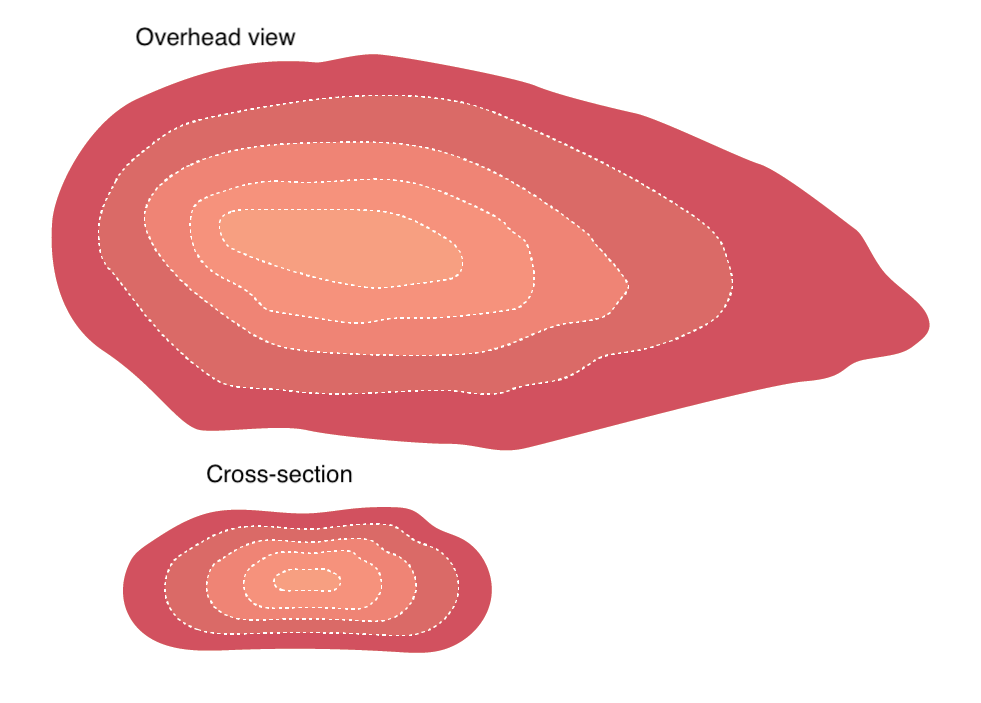
The physical footing of carryover cooking
There are a few basic physical laws that govern carryover cooking in foods. And, although they tin can seem a piddling daunting, the basic ideas aren't difficult to grasp.
The second police force of thermodynamics
As yous may have learned in center school, the 2d law of thermodynamics tells us that the caste of disorder in a system will increase unless work is performed on information technology. Which is to say that unless y'all plug something in like a fan or fridge, heat tin merely flow "downhill."
For example, if yous identify a cold drink on a hot windowsill on a summer's twenty-four hour period, the drink will not somehow get colder, surrendering its meager heat to further estrus the windowsill. Anyone knows that the beverage volition heat up. And if, after a few minutes, y'all option the drinking glass back up, the spot where it had been sitting will have cooled down—having surrendered some of its heat to warm the drinkable.
What on earth does this have to do with carryover cooking? A lot, actually. It means that the hot outside of a roast will share its heat with the colder within, and it will do so with accented physical certainty. This is the central principle of carryover cooking. The other principles we mention hereafter are all secondary to information technology. This tendency of rut to be shared until an equilibrium is reached is exactly what causes carryover cooking, and agreement it on that
Estrus capacity
The adjacent concept to understand in carryover cooking is oestrus capacity. Oestrus chapters is the ability of a sure substance to store thermal free energy. And, past extension, heat capacity
Some other idea experiment: Imagine, if you volition, a piece of aluminum foil within of a 350°F (177°C) oven. Without much fear of repercussion, you might reach into that oven and pull out that sheet or wad of foil. You've probably grabbed foil from an oven before. However, if even a single drop of 350°F (177°C) oil were to splash on your hand while you were deep-frying something, you would scream in pain!
What gives? Weren't the foil and the oil at the same temperature? Well, yes, in fact, they were, but oil carries more thermal free energy per degree of temperature than does aluminum. Depending on the type, oil can comport as much every bit 2.2 times the thermal energy of aluminum at the aforementioned temperature. And h2o carries fifty-fifty more than! Leaving the units off for the sake of understanding the raw numbers, aluminum has a heat capacity of 0.91, olive oil has 1.97, and h2o has 4.xix! That's why y'all tin can heat a pot of oil to 350°F (177°C) in roughly the same amount of time information technology takes to heat a pot of water to boiling, 212°F (100°C).
What those heat capacity measurements represent in physical terms is the corporeality of free energy (measured in Joules) needed to heat 1 kilogram of each substance one degree Kelvin (1.8°F).* And so one kilogram of water takes 4.xix joules to raise its temperature 1°C (1.eight°F), simply aluminum merely takes 0.91 joules for the same temperature change.
*These heat capacities are based on mass. Volumetric rut capacities can also be derived that measure the energy required to change a sure volume of a substance by 1°C. H2o still has a much higher specific oestrus capacity in that case.
Oestrus transfer formula (Heat equation)
The way that estrus distributes itself through a substance is, equally noted above, unidirectional. But the movement can be more accurately described by the estrus equation.
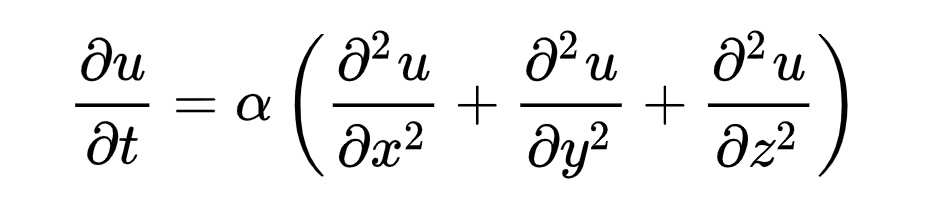
The heat equation is a handy (if admittedly slightly intimidating) partial differential equation that describes oestrus moving over fourth dimension. What it ways is not hard to grasp, even if the mathematics themselves may be.
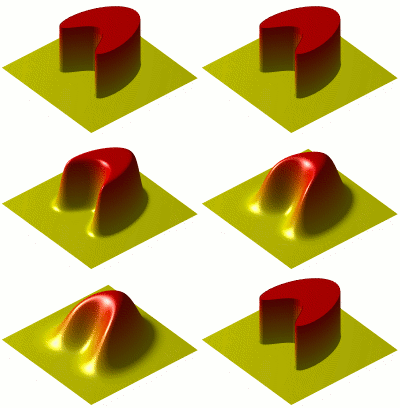
What the estrus transfer formula means, physically
The heat equation says that heat is transferred directly across next points…information technology doesn't skip around. Information technology as well says that areas with a greater temperature difference volition change more quickly—a 100°F plate stacked on meridian of a xl°F plate will estrus the cooler plate faster than a l°F plate stacked on top of it. That's basically information technology: Adjacent heating, faster with a greater differential.
This is one of the about important physical principles in carryover cooking. It explains the heat flow inside a piece of steak, a roast, or even a loaf of breadstuff. Oestrus is passed down the line from particle to particle, each bumping into the next and averaging out their free energy, with more energy beingness pumped in from the oven/grill/pan each moment. This is what causes the phenomenon we telephone call temperature gradients, the differences in temperature that be between the hot surface of your food and the cooler thermal middle. Temperature gradients explain why you meet a greyness band around a cantankerous-section of improperly cooked steak: the outside was hotter than the within and cooked faster.

The second law of thermodynamics says that the energy being pumped into the food tin can merely flow to an area of lower free energy, and rut capacity tells us how much energy is necessary to raise the temperature of the food by a certain amount, and the heat equation tells us how estrus moves and where the temperature gradients come from.
Factors that touch on carryover cooking
With that grounding in the physics of estrus, we can expect more closely at how rut operates in food while cooking. And 1 of the start things to think nearly in that regard is thermal mass.
Thermal mass
Thermal mass is roughly equivalent to total heat chapters—not the capacity per kilogram, but the capacity of the entire piece of food (or cookware) as a whole. (A New York strip steak has the same heat capacity per gram as a whole curt loin, but nowhere near the total capacity of the whole because the brusk loin is bigger.) A whole loin has more than thermal mass than a steak, and that ways there's more estrus to go around when the loin is removed from the cooking environment. So the size of any given piece of food has a office to play in carryover cooking.
Geometry: the shape of the nutrient
How the food is cut matters, too. A single steak has a lot of surface surface area, compared to its volume. That ways there is a lot of infinite to vent oestrus into the air, cooling a larger portion of the meat much faster. Think of a steak compared to v steaks stacked together (like a loin). The amount of space available for oestrus to escape is proportionally much smaller for the loin.
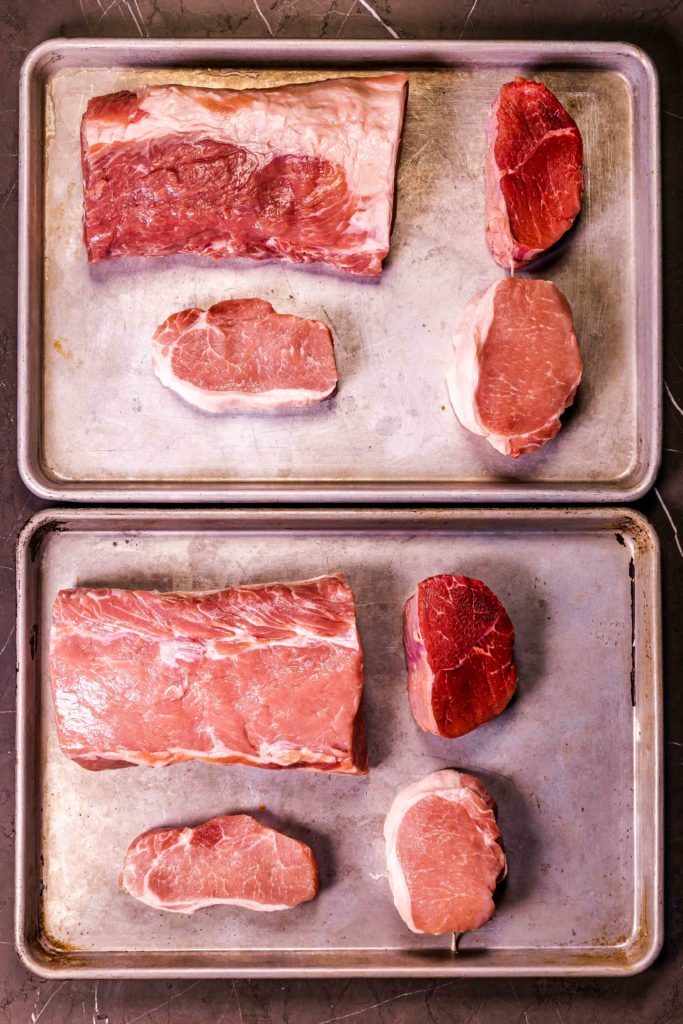
Ultimately, a sphere is the shape most prone to carryover cooking (i.eastward. least prone to cooling) of all, because it has the to the lowest degree expanse for a given book. Interestingly, a blimp turkey is roughly spherical in shape. That's why information technology's a good reason to not stuff your turkey and to melt information technology to a slightly lower temperature!
Cooking temperature
Mayhap the most straightforward factor for carryover cooking is the temperature of the cooking surface or oven itself. A loftier oven volition pump more heat into any cut than a low oven volition, and the extremes in temperature differential from the cooler center of the meat compared to the hotter surface volition be much greater, causing more than carryover cooking once you remove information technology from the oven.
Carryover cooking experiment
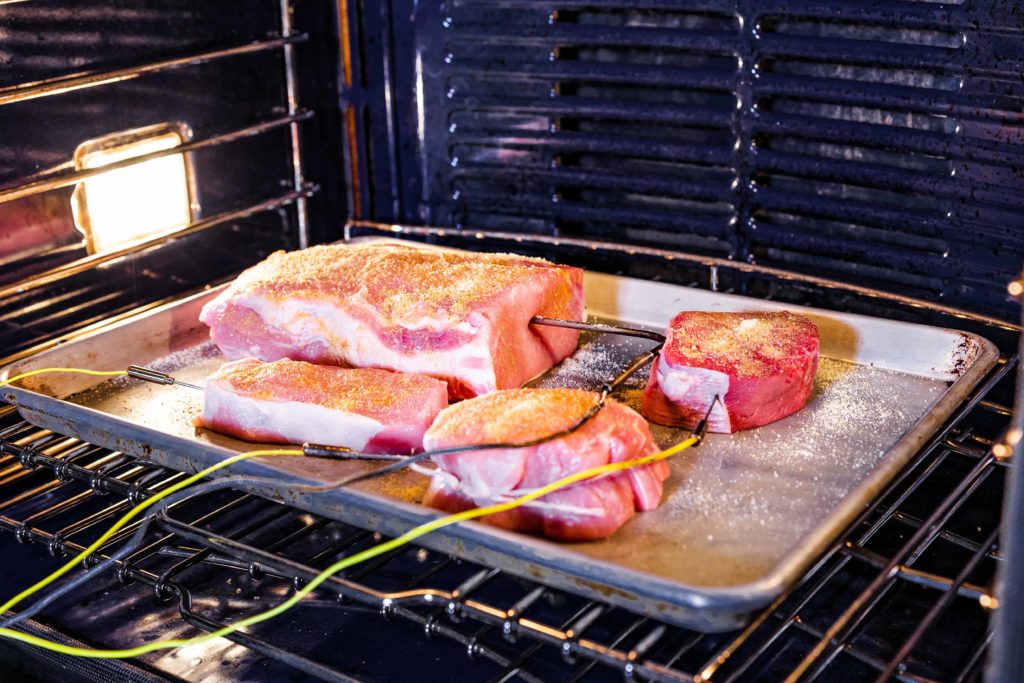
To demonstrate how carryover cooking is afflicted past mass, cooking temp, and the makeup of the food, we performed an experiment in our kitchen. We cooked ii sets of meat, ane in an oven ready to 300°F (149°C), the other in an oven set to 425°F (218°C). Each set of meat consisted of a pork chop, a big chunk of pork and a large chunk of beef of comparable mass and shape to each other, a chicken breast, a fillet of salmon, and a section of pork loin.
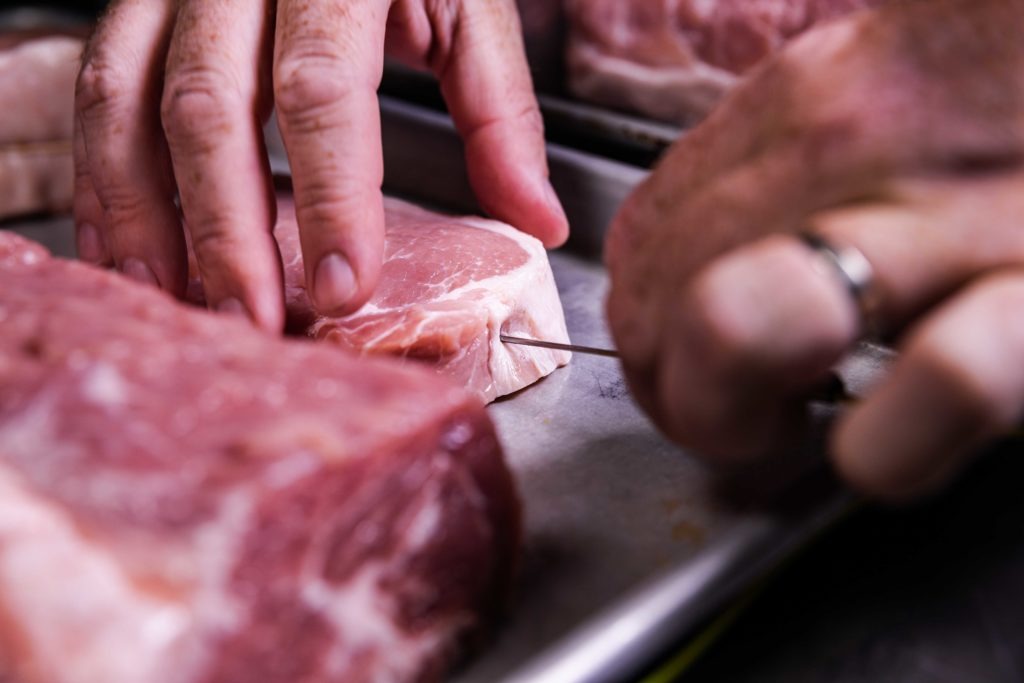
We probed each piece
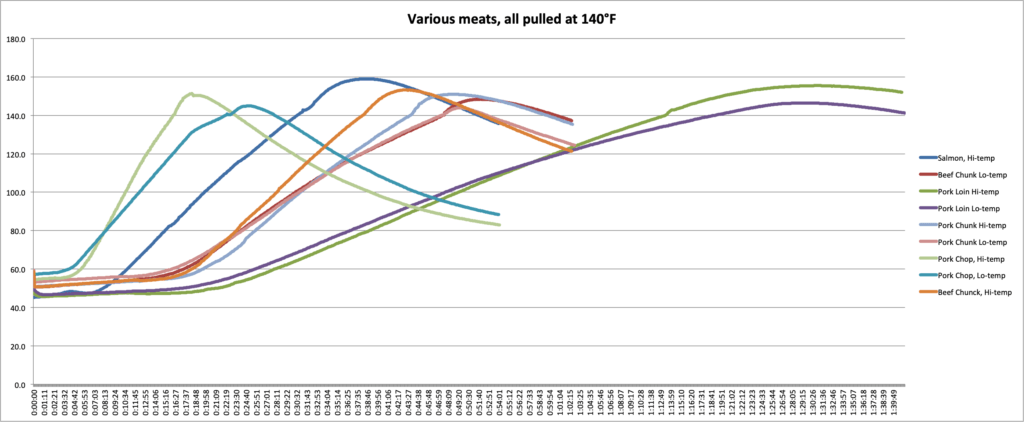
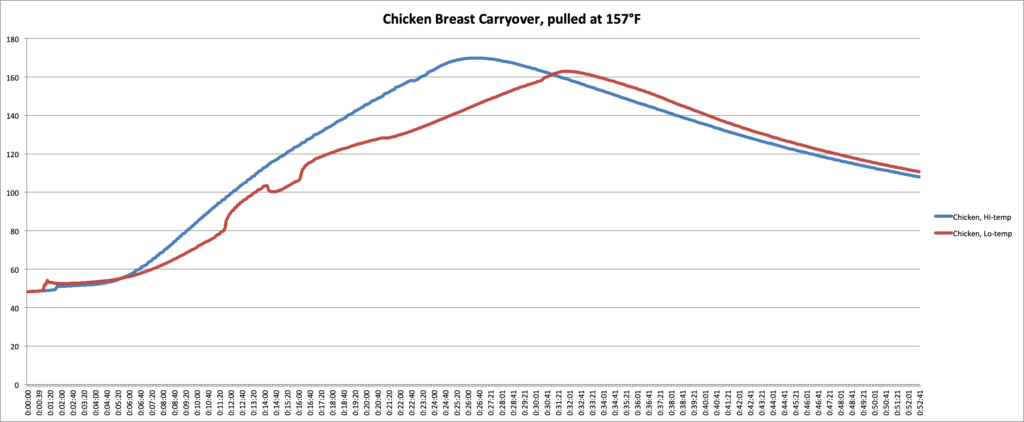
In the graphs and chart below, yous tin see the data we nerveless.
| Particular | Mass | Pull temp | Highest temp achieved | Total carryover |
|---|---|---|---|---|
| Pork chop, cooked at 300°F | 150 one thousand | 140°F | 144.ix°F | four.ix°F |
| Pork chop, cooked at 425°F | 150 chiliad | 140°F | 151.5°F | 11.v°F |
| Beef chunk, cooked at 300°F | 260 grand | 140°F | 148.4°F | 8.4°F |
| Beef chunk, cooked at 425°F | 286 1000 | 140°F | 153.ii°F | 13.ii°F |
| Pork clamper, cooked at 300°F | 274 g | 140°F | 143.ix°F | iii.nine°F |
| Pork clamper, cooked at 425°F | 340 g | 140°F | 151.0°F | 11.0°F |
| Pork loin, cooked at 300°F | 1229 thou | 140°F | 146.five°F | half dozen.5°F |
| Pork loin, cooked at 425°F | 1329 g | 140°F | 155.5°F | xv.5°F |
| Salmon, cooked at 300°F | 276 g | 140°F | 147.3°F | vii.3°F |
| Salmon, cooked at 425°F | 314 1000 | 140°F | 159.0°F | nineteen°F |
| Chicken, cooked at 300°F | 198 g | 157°F | 162.9°F | seven.9°F |
| Chicken, cooked at 425°F | 245 g | 157°F | 169.9°F | 12.ix°F |
We can make several key observations by examining this data.
- Outset, we tin see the effect that cooking temperature has. In every case, the meat that was cooked at the college temp experienced more carryover than meats cooked at the lower temps. A pork loin cooked at 425°F (218°C) experienced nine°F (5°C) more carryover than a loin cooked at 300°F (149°C). If you desire a pork loin that is not overcooked and you're cooking at that college temperature, you'll need to pull it several degrees earlier!
- Second, nosotros can come across how mass affects the carryover. For the three pieces of pork cooked at each temperature, you can see the carryover increasing as mass increases. In the 300°F (149°C) oven, the chop had 4.ix°F (ii.7°C)of carryover, while the loin had 6.5°F (3.6°C). In the 425°F (218°C) oven, the carryover increased from 11.5°F (six.4°C) in the chop to 15.5°F (8.vi°C) in the loin. (I don't think the chop and the chunk were different plenty to overcome experimental error in this experiment. Hence the chunk experiencing slightly lower carryover.)
- And tertiary, we can see how the kind of meat affects the carryover. The beefiness chunks and the pork chunks had very similar masses and shapes but had very dissimilar carryover in each case. In the cooler oven, the beef carried over by eight.4°F (four.vii°C) while the pork only carried over past 3.9°F (ii.ii°C). In the hotter oven, that gap remained: the beef had xiii.two°F (7.3°C) of after-cooking carryover and pork had just 11.0°F (six.i°C).
Sometimes, after publishing a mail that mentions carryover cooking, I go questions in my e-mail or on the post itself about why we don't publish a carryover cooking table. A close look at the factors above should help to reply that question. With so many variables in a cook, publishing a chart that shows carryover times would be practically impossible. We'd need an entry for every cook temp, for every mass, for every shape, and for every kind of meat or bread. That doesn't hateful yous should give up hope of mastering your cook. It merely means you'll have to get a experience for how much carryover to wait given the specific circumstances of each cook.
Using tools such as the ChefAlarm ® , with its Min- and Max-temp display can help y'all constitute the carryover for any given recipe. Use it on a roast craven to find out how much the meat cooks subsequently you take it out of your oven, and then adjust your pull temp accordingly. Write the proper pull temp in your recipe so you tin get information technology right again next fourth dimension. With a little practice, you lot'll be nailing temperatures each and every time you cook.
Conclusion
When cooking, temperature matters. Using a thermometer to gauge your pull temps is in every mode meliorate than using physical artifacts to bank check doneness. And if pressing a steak or cutting a craven is the wrong mode to hitting an exact temperature, how much worse are they for determining a temperature you have not yet arrived at?
If you desire to perfect your dish, you have to account for carryover cooking, and the but way to exercise that is to use authentic, reliable temperature instruments. Yes, in that location is a learning curve equally you account for cook temp, the size of your food, and the kind of nutrient you are cooking. But as you larn how those variables operate in your ain kitchen, you'll starting time to elevate your cooking in ways you've never imagined.
Store at present for products used in this post:

kleinschmidtmong1940.blogspot.com
Source: https://blog.thermoworks.com/thermometer/carryover-cooking-what-happens-after-you-cook/
0 Response to "what happens if my ham doesnt get to 140 degrees and i finish cooking the next day in the oven"
إرسال تعليق